Keeping Hold of the Universe
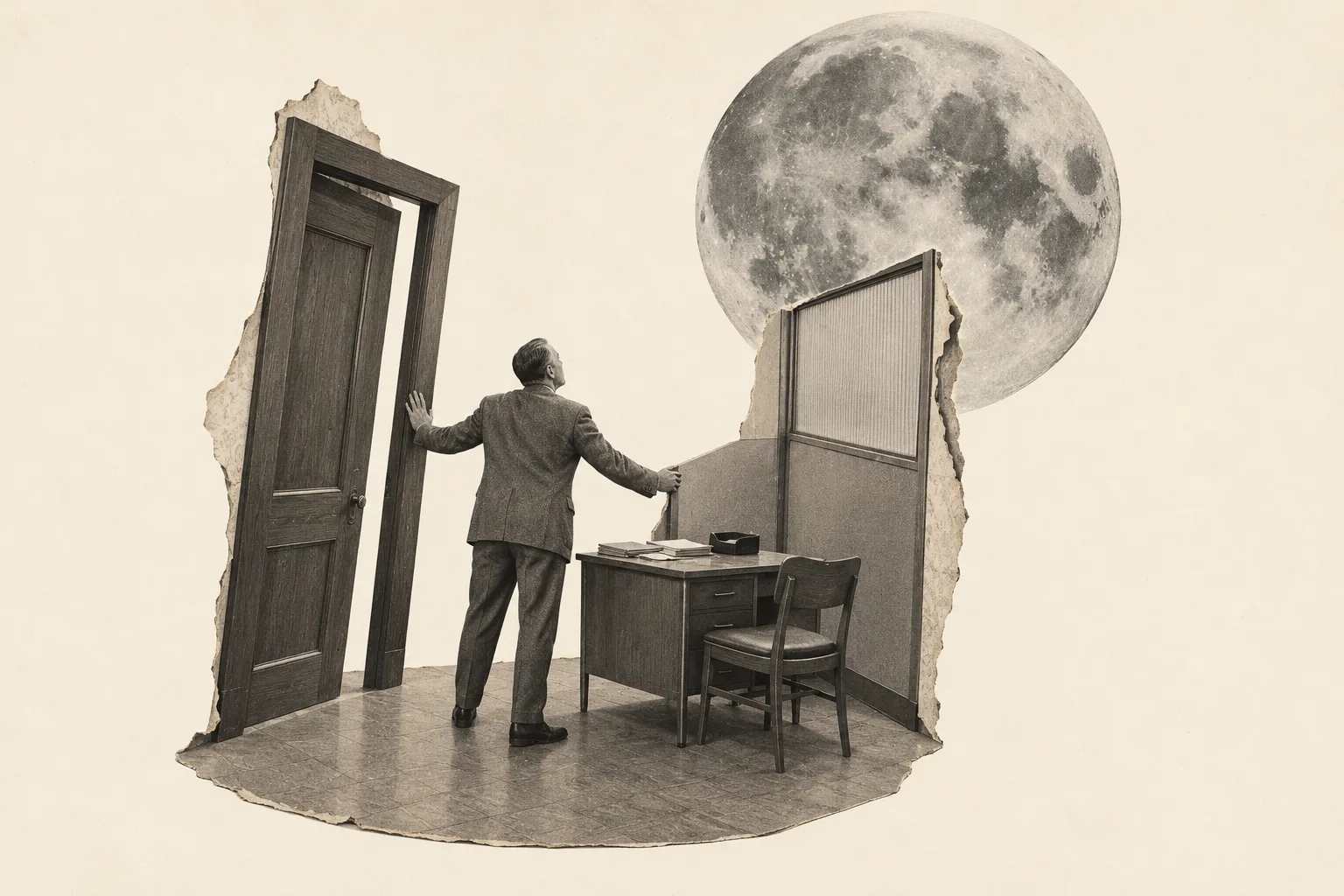
In Small Gods, Terry Pratchett describes Brother Nhumrod touching the things around him, “as if he was afraid the universe would disappear if he didn’t keep hold of it.” Pratchett adds that his behaviour is normal for someone who has survived fifty years inside the Citadel. Small Gods, p. 17
The image keeps coming back in conversations with executives about AI. There is enthusiasm for getting closer to the work, followed by a peculiar hesitation when the distance actually starts to close. Someone reaches for a meeting, a reporting line, a process through which the unfamiliar thing can become familiar again.
Agile promised something similar more than twenty years ago: shorter distances between people, working software and the experience of using it. Its original principles put people together and trusted them to get on with the job. Agile principles
The version we often encountered accumulated Scrum Masters, prescribed meetings, Jira formats and governance around Kanban boards. There were increasingly elaborate ways to establish whether people were working in an agile way. Getting closer to the work had acquired a substantial amount of work around it.
Within that arrangement, an executive could sponsor change while retaining a familiar relationship to it. Someone else would organize it, carry it out and report back. The ambition could be sincere, and the distance could remain.
AI makes some of that distance optional. Work that once needed to be assigned can sometimes be done while the person asking is still there. An idea can become something they can try, question and change before it has travelled through the usual sequence of other people’s interpretations.
That brings the uncertainty closer too. A request that sounded clear becomes less clear in the making. A result exposes a question nobody had thought to ask. The person who commissioned the work encounters the unfinished thinking that would ordinarily have happened elsewhere.
This is the disorientation we keep noticing. Knowing how to set work in motion has been part of someone’s competence, sometimes for decades. Now there is a much shorter route between an intention and its consequences, and their familiar way of participating no longer accounts for everything happening in front of them.
Nhumrod’s gesture comes to mind when the response is to reach for the surrounding apparatus: another update, another owner, another meeting to establish where things stand. Those arrangements have been how someone kept contact with the work. As the work becomes more directly accessible, they can find themselves holding on to the things that used to stand between them and it.
Original editorial illustration generated with AI for this essay.